
\n\n
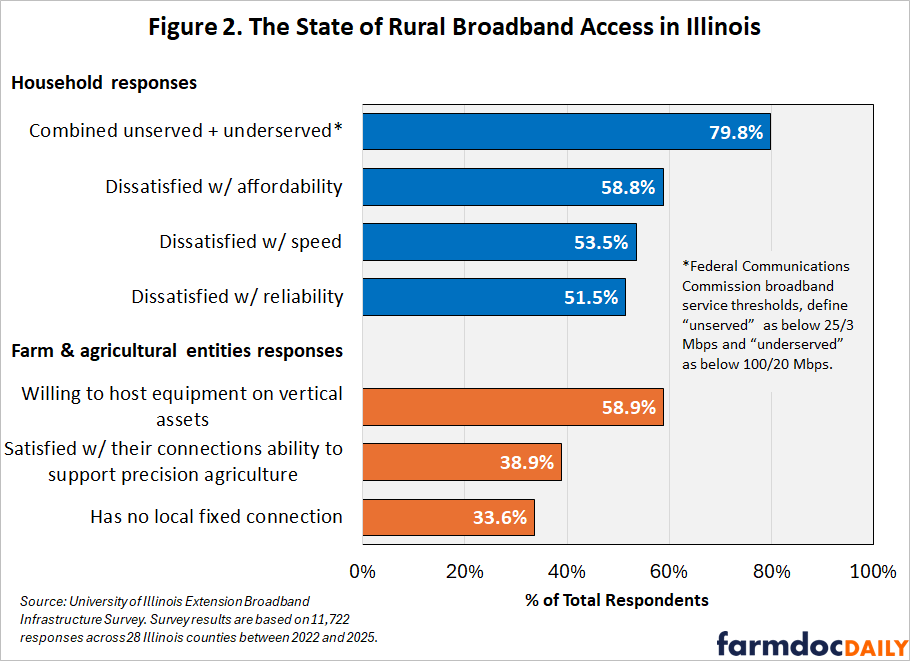
A new University of Illinois Extension survey of more than 11,700 rural households and 6% agricultural respondents in 28 Illinois counties shows that while broadband reach has grown, quality remains a major problem. Nearly four‑fifths of residents with a fixed line fall below FCC benchmarks for service speed, and more than half are unhappy with the speed and reliability of their connections. Affordability is also a concern, with about 60% of households rating their broadband as too expensive.
Farmers face a similar shortfall. Only 38.9% say their current connection supports precision‑agriculture applications, and a third have no fixed broadband at all. Yet the same survey found that 58.9% of agricultural entities are willing to host broadband equipment on their property, offering a potential pathway to address the “last‑mile” challenges that keep many farms offline.
Federal support is flowing. The USDA’s Rural Development program earmarked $267 million in FY 2026 for broadband expansion to households, farms, businesses, and community institutions, complementing the $42.45 billion BEAD program that funds mapping and build‑out efforts nationwide.
Why it matters: High‑quality, affordable broadband is critical for modern farming—enabling automated equipment, data‑driven decision‑making, and higher land values—as well as for telehealth, remote work, and education in rural communities.
What to watch next: 1) How USDA grant allocations translate into new fiber or fixed‑wire builds, especially in the counties flagged as “underserved.” 2) Deployment of farmer‑hosted infrastructure, which could accelerate last‑mile connections. 3) Ongoing monitoring of speed‑test data to see whether the next wave of funding improves the 79.8% of rural residents currently classified as unserved or underserved. [[1]]