
\n\n
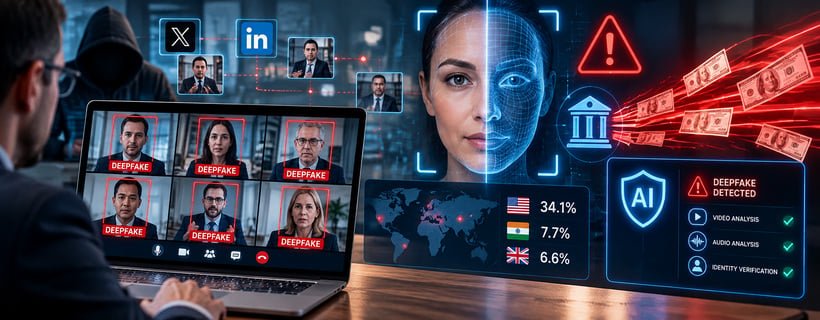
The latest identifAI report reveals that deepfake‑enabled fraud now totals $40 billion, with synthetic video accounting for 42.7% of attacks and voice cloning 21.9%. The United States bears the heaviest burden, representing 34.1% of incidents, while India and the United Kingdom follow at 7.7% and 6.6% respectively. Cybercriminals harvest executive footage from platforms like X and LinkedIn to train models that can impersonate CFOs and other senior staff, as illustrated by a Hong Kong finance worker who transferred $25.6 million after a deepfake video conference.
In response, security vendors are rolling out real‑time detection services. Netarx’s new AI Defense API claims to "detect and neutralize deepfakes, social engineering, identity spoofing, and fraud across every channel," while Onecom’s upgraded Vox platform now flags synthetic voices during calls and Pindrop’s BotStopper identifies AI callers within seconds, leveraging a registry of over 5,000 AI voices.
Governments are also sounding the alarm. Dubai Police’s Future Foresight Centre warns that increasingly convincing AI‑generated media threatens identity theft, fraud and the reliability of digital evidence. Meanwhile, OpenAI has added a ChatGPT safeguard that blocks realistic election‑related images and is deploying SynthID watermarks, though independent testing by the Brennan Center shows determined actors can still bypass these controls.
The convergence of massive financial losses, emerging detection ecosystems, and regulatory scrutiny underscores why deepfakes now matter beyond novelty. Stakeholders should monitor three developments: (1) the evolution of “fraud‑as‑a‑service” platforms that automate synthetic media creation, (2) the adoption of AI‑driven verification standards such as watermarking and AI‑voice registries, and (3) legislative initiatives like the Protect Elections from Deceptive AI Act that may mandate labeling and provenance data. As tools for both attack and defense mature, continuous vigilance will be essential to protect identities, financial transactions, and democratic processes. [[1, 2]]